November 10, 2025 | Kate Rainford | Click To View Original Article
BWC Terminals’ vice president of HSEQ, Tommy Bankhead, explains how a robust health and safety policy can lead to industry recognition and success
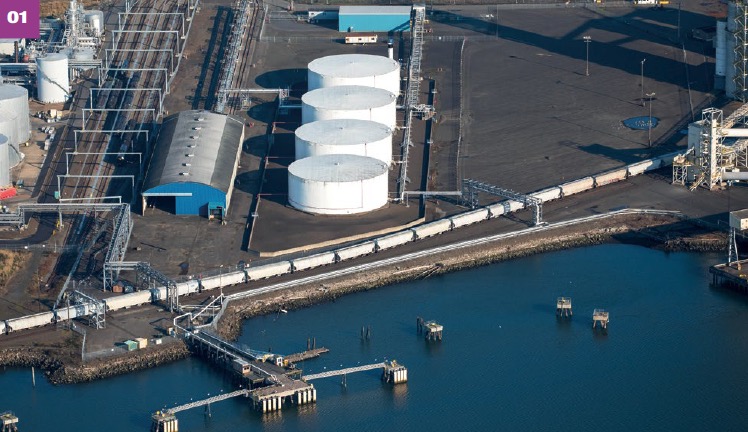
BWC OPERATES 22 independent bulk liquid storage terminals across 12 US states and one in Canada. One of these terminals, located in Washington, USA, is the BWC Grays Harbor facility, which offers a storage capacity of 320,000 barrels (50,875 m.), two deep-draft berths, two truck bays, and 12 rail loading spots. ‘The facility benefits from direct access to the Pacific Ocean, making it Washington State’s only deepwater port on the ocean to service Canadian and Pacific trade routes,’ explains BWC’s vice president of health, safety, environment and quality (HSEQ), Tommy Bankhead.
In particular, the Grays Harbor terminal holds a strategic advantage in the changing fuel market landscape. ‘With Washington’s Clean Fuel Standard (CFS) driving a shift from petroleum diesel to lower-carbon alternatives, the terminal is well-positioned to take advantage of the rapid adoption and transportation of renewable diesel and biofuels taking place on the West Coast,’ Bankhead says.
BWC manages a range of products, including agricultural goods, specialty chemicals, and refined products. Aboveground storage tanks are leased to customers who transport chemical products to the terminal via ships and rail cars. BWC operators unload these ships and rail cars into the terminal’s four aboveground storage tanks. Following the customer’s instructions, chemical products are then transferred from the tanks to rail cars or tanker trucks for shipment to their clients.
‘Our philosophy is to remain productagnostic and to provide storage and logistical solutions tailored to the specific products our customers are interested in. As a result, we make it a point to adapt our services to meet changing customer needs,’ says Bankhead.
BUILDING A FOUNDATION
‘Our HSEQ policy focuses on key areas essential for our operations,’ explains Bankhead. ‘We implement this policy across our terminals through a comprehensive framework that addresses routine and emergency conditions, effectively managing risks and potential incidents. Safety is ingrained in our culture, supported by continuous training and strong management commitment.’
Setting high standards in products and services are crucial for meeting customer expectations and building trust – and BWC Terminals effectively emphasizes continuous improvement through employee involvement and ongoing training. ‘This integrated approach is fundamental to BWC Terminals’ sustainable success and our commitment to stakeholders and the environment,’ says Bankhead.
‘We also prioritize environmental stewardship by monitoring our impact, ensuring compliance with laws, and reducing emissions, all while considering community well-being,’ says Bankhead. ‘Our integration of ESG principles into operations reinforces our commitment. And our achievements that demonstrate this commitment include VPP Star certification at Grays Harbor and Texas City, along with multiple safety awards, such as the ILTA Safety Excellence Award and the national AEU Safety Award.’
EXCEEDING SAFETY STANDARDS
Most recently, the terminal has been awarded a star certification under OSHA’s Voluntary Protection Program (VPP) – the highest level of recognition in the VPP scheme. Bankhead emphasizes the importance of health, safety, environment, and quality across all BWC Terminals’ sites.
‘Our HSEQ policy is fundamental to the sustainability of the company’s operations,’ he says. ‘Its systems, policies, and procedures address both routine and emergency situations to effectively manage risks, threats and incidents.’ Safety is embedded in the BWC Terminals culture, through ongoing training and the empowerment of employees, and it is reinforced by management to achieve industry-leading results,’ concludes Bankhead.
The Grays Harbor terminal has not experienced an OSHA recordable incident in over 10 years – something the team and Bankhead are very proud of. So it only made sense that the next step would be to find new ways to enhance the already-rigorous safety culture. ‘Our goal each year, company-wide, is to achieve zero injuries and illnesses,’ says Bankhead. ‘Setting a goal other than zero would imply that we accept a certain number of injuries and illnesses as acceptable – and that’s not the BWC way. Pursuing accreditation in the OSHA VPP at Grays Harbor presented us an opportunity to not just meet, but exceed industry safety standards.’
According to Bankhead, achieving this certification establishes a collaborative platform where employees can work together to continuously enhance safety measures. BWC Terminals has been able to foster a culture of transparency, enabling employees to express their insights and make suggestions regarding safety practices and policies. ‘By actively involving employees in safety decision-making processes, the certification not only empowers them but also contributes to a safer working environment within the facility,’ he says. ‘This initiative encourages open communication, ensuring that everyone has a voice in creating and maintaining effective safety protocols.’
EMPOWERING EMPLOYEES
‘Our HSEQ strategy is crucial for the sustainability of all BWC’s operations,’ says Bankhead. ‘We have implemented comprehensive systems, policies, and procedures to effectively manage both routine and emergency situations, addressing potential risks, threats, and incidents. Safety is a core aspect of our company culture, supported by ongoing employee training that promotes principles aimed at achieving industryleading safety outcomes. As a result, we are dedicated to enhancing all our facilities to achieve VPP certification.’
But achieving this is a significant, time-consuming process. ‘The fact that one BWC terminal has obtained this certification before another does not necessarily indicate greater safety success,’ says Bankhead. ‘We are committed to helping all our facilities work towards this, and many of our other terminals are currently at various stages of the VPP evaluation process.’
So what helps Grays Harbor stand out? The terminal uses a variety of digital safety observation and reporting systems, but the key to effective health and safety monitoring lies with its employees. ‘Achieving VPP certification requires annual self-examinations, which provide the Grays Harbor team with an opportunity to continuously assess our terminal’s practices and ensure that safety is a priority in our decision-making process,’ explains Bankhead.
All employees have the authority to stop work if they observe unsafe acts or believe that unsafe conditions exist. Additionally, employees take turns conducting the monthly terminal inspection. This inspection involves a comprehensive seven-page checklist used to document any hazards discovered and to ensure that certain regulatory requirements are met, such as inspecting stormwater outfalls and spill response kits,’ says Bankhead.
FUTURE-PLANNING
BWC is well-positioned on the US West Coast to meet the rising customer demand stemming from the energy transition, according to Bankhead. ‘Our Grays Harbor facility has received numerous inquiries from customers regarding energy transition projects and is actively collaborating with these entities to provide solutions.’
He continues: ‘For instance, and while not specific to Grays Harbor, we recently completed a state-of-the-art terminal at the Port of Stockton, California, that includes the first newly constructed Marine Oil Terminal Engineering and Maintenance Standards (MOTEMS)-compliant dock built in California in nearly 30 years.’ The aim is that this facility will play a vital role in advancing the renewable fuels supply chain across the state. It has been designed to safely and efficiently transfer renewable diesel and biodiesel from marine vessels, supporting California’s efforts to decarbonize hard-to-electrify sectors such as heavy-duty transportation.